
Plym Yacht Club Moorings
Plym Yacht Club Moorings
There are several trots of moorings on the river (What is a Trot? See below). Deep water trots are accessible at all states of tide and have a minimum tidal depth of 2 metres. There are other trots available with restricted tidal depth of 1 metre and not suitable for fin keeled vessels.
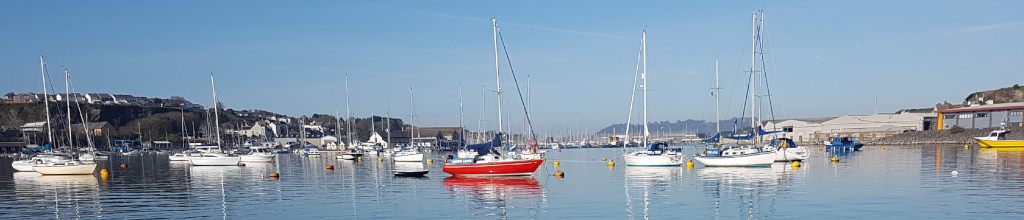
Plym Yacht Club licences moorings on the River Plym and theses can be seen from Oreston green outside the club. The moorings are held on a renewable annual licence by members of the Plym Yacht Club.
The club administers it's own waiting list for members and non members. To hold a PYC mooring you need to join the club when offered a mooring.
Plym Yacht Club Moorings - Frequently Asked Questions
Basics of a trot of moorings
We have all heard someone say “on the trot” or using some context “I’ve been to three Argyle games on the trot”. Basically it means in “succession” or “one after another”.
Anyway in our application a trot mooring is a string of moorings one after another all joined together. An individual trot mooring (or fore and aft mooring) consists of two buoys joined by a trot rope.

So in this trot of moorings there are five buoys. Now that could be four moorings or in areas with high tidal flow or constricted waters, one or both of the end buoys could be part of a stretcher. This acts to keep the whole trot in place and is NOT a mooring. For instance, both the Oreston Upper trots have stretcher buoys which are NOT part of a mooring.
Below you can see what happens if a trot rope breaks or is missing when a vessel is not on the mooring. NEVER leave your mooring without the trot rope in place. Vessels can swing about and be damaged.
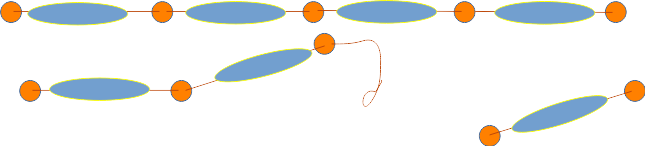
This side view above shows what goes under the water to keep the Trot in place. The boats always move together regardless of wind or tide, unlike a swinging mooring. The boats can only move as far as the slack in their riser chains allows. The slack will abviously vary dependent on the state of tide. Viewed end on, vessels on the trot may seem close together. Viewed from the side, will always show the true gap between vessels. The ground chain is so heavy its unlikely to move and in some applications is fixed in place by anchors.

Picking up a Trot mooring
[embedyt] https://www.youtube.com/watch?v=w-WcQ7p0d0A[/embedyt]
Mooring Lines
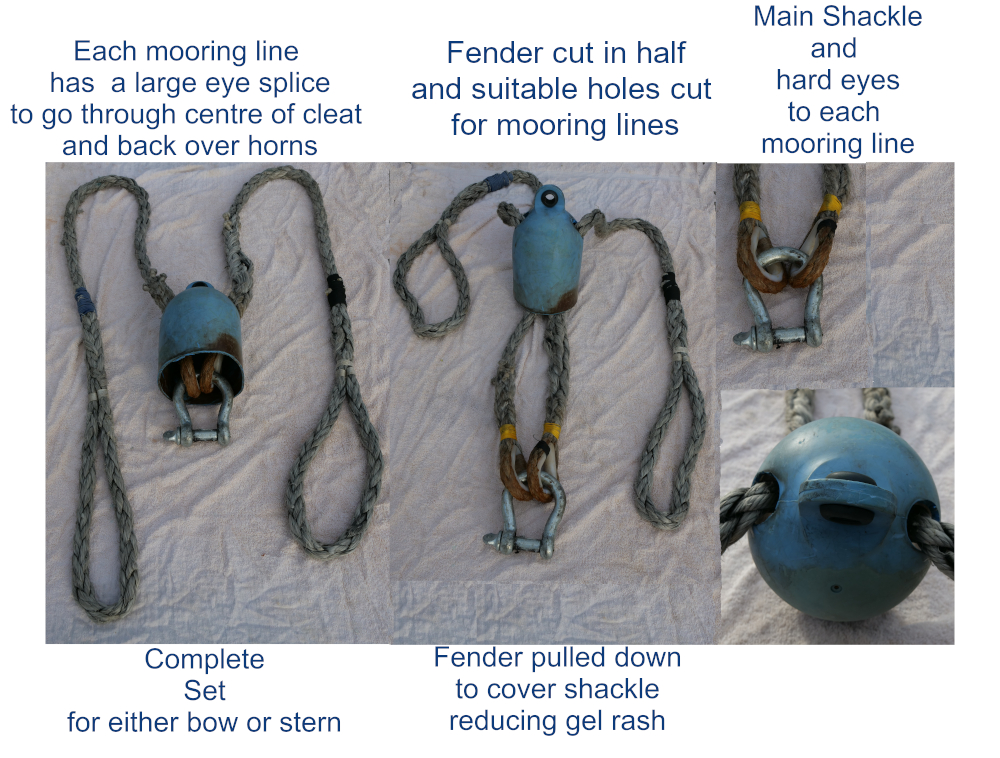
Mooring Lines are generally those used to keep the boat on its mooring. These are different for the different mooring you have, marina pontoon, swinging mooring, fore and aft or trot moorings. Your permanent mooring needs a set of mooring lines made up by yourself or any yacht rigger.
For a fore and aft or trot mooring, ideally, you need a pair of mooring lines to each buoy.

Layout and mooring Identification.
There are four trots of moorings on the river Plym. Each trot has a name. Each buoy is numbered. So a mooring is identified by the initials of it's trot name (U for upper or O for Lower if applicable) and two buoy numbers. Either buoy number can be fore or aft.
For example OUI 37-38 is a mooring on the Oreston Upper Inner trot between buoys 37-38

Mooring Data
| Mooring Trot | 2022 to 2023 | Mooring | Buoys | Vessel Max LOA | Keel Type | Min Tidal Depth | |
|---|---|---|---|---|---|---|---|
| CB | £873.00 | 15M | All | 11M or 36ft | Bilge or Motor | 1M | |
| O/I/30 | £917.00 | 11M | All | 9.23M or 30ft | Fin Bilge or Motor | 2M | |
| P | £873.00 | 10M | All | 7M or 22ft | Fin, Bilge, Motor or Dinghies | 1M | |
| O/O/32 | £1,014.00 | 12M | 8 31 | 9.84M or 32ft | Fin Bilge or Motor | 2M | |
| O/O/36 | £1,125.00 | 15M | 1 8 | 11M or 36ft | Fin Bilge or Motor | 2M |
Mooring Access
Moorings can be accessed from the Slipway at the northern end of Oreston Green. Limited car parking is also available here. Dinghy storage is available in the Dinghy Park which is run by Plymouth City Council. To find out about availability contact the Piermaster: on 07771 663 560.
Alternative Dinghy Storage is available from Plymouth Yacht Haven Quay Yacht Haven Quay, Breakwater Road, Plymouth, Devon PL9 7FE
Call 01752 481190
Location w3w: Here
